As AI-generated content becomes increasingly prevalent, many recruiters are feeling pressure to ensure authenticity in candidate applications. In response, some have turned to AI detectors, hoping these tools will help distinguish between human-created content and AI-assisted work. However, recent research warns against relying on these detection tools: AI detectors are often inaccurate and could do more harm than good in the recruitment process.
The RAID paper, a comprehensive study on AI detection tools, highlights some alarming findings that recruiters should consider. The results indicate that even the most advanced AI detectors come with high false positive rates, especially at levels of detection accuracy typically demanded in recruitment. The data from this study suggests that attempting to “police” applications with AI detectors could actually lead to unjust rejections, creating serious risks of bias and candidate mistrust. Below, I’ll break down why this approach is problematic—and offer suggestions for a more forward-thinking approach to candidate assessment.
Key Issues with Relying on AI Detectors
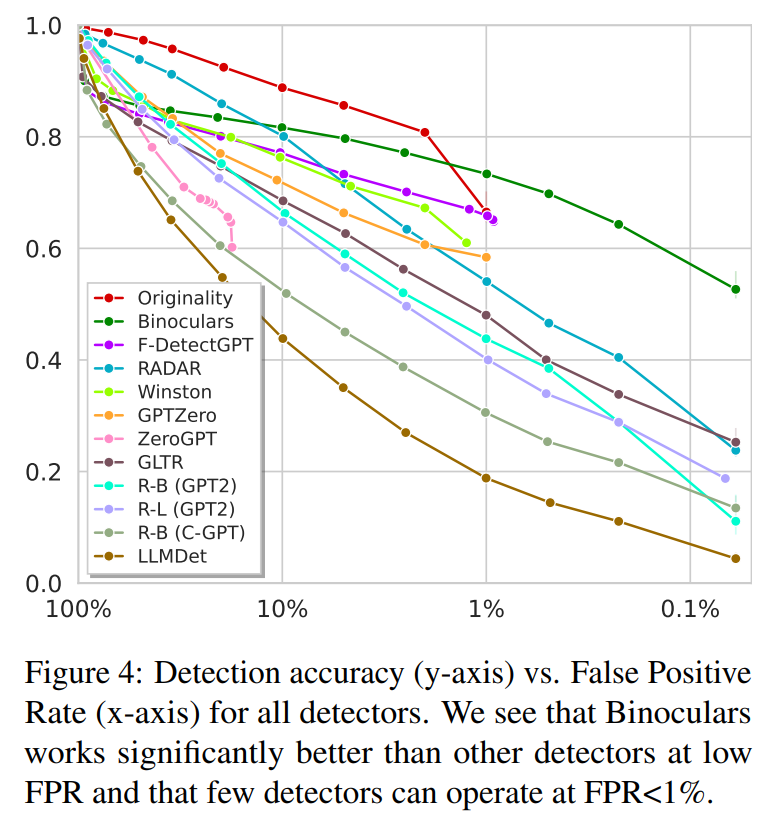
- High False Positive Rates: The RAID study evaluated multiple AI detection tools, including industry-leading ones like GPTZero, Originality.ai, and Copyleaks, and found that even at a 1% false positive rate, many tools detect only 60% or less of AI-generated content accurately. At a 10% false positive rate, detection accuracy climbs to around 80%, but this still means that a significant portion of genuine human-written content could be wrongly flagged as AI-generated. In recruitment, where accuracy is crucial, these error margins are too high, potentially leading to unjust rejections of genuine candidates.
- Bias Against Non-Native English Speakers and Neurodivergent Individuals: The study also revealed that AI detectors are more likely to flag simple or formulaic writing as AI-generated. This disproportionately affects non-native English speakers, who might use straightforward language, as well as neurodivergent individuals who may have a unique and consistent writing style. As a result, relying on AI detectors could unintentionally exclude a diverse pool of candidates, undermining diversity and inclusion efforts.
- Creates a Culture of Suspicion: Using detection tools to scrutinize the authenticity of every application can foster a climate of distrust. Candidates may feel that recruiters are more focused on “catching” them out rather than evaluating their skills and potential. This adversarial approach risks damaging the candidate experience, especially at a time when employer brand and candidate relationships are critical for attracting talent.
- Easily Fooled by AI "Humanizers": Another key takeaway from the RAID study is that AI detectors can be tricked by tools specifically designed to bypass them, such as “humanizer” software that adjusts AI-generated content to appear more human-written. This capability could lead to an arms race between AI generators and detectors, ultimately creating a scenario where recruiters are always playing catch-up rather than assessing candidates based on meaningful criteria. In fact, I share a prompt in my 'AI Enablement For Recruiters' training that beats an AI detector every time: "write with a high degree of perplexity and burstiness".
The Case for Rethinking Application Assessment
Rather than relying on imperfect AI detectors, this research should serve as a wake-up call to rethink how we assess candidates in an era where AI is part of the working toolkit. Here’s how recruitment can evolve:
- Embrace Skills-Based Assessments Over Text-Based Evaluations: Instead of focusing heavily on CVs, cover letters, and other written application components, consider shifting towards practical, skills-based assessments using platforms like Arctic Shores. Real-world simulations, problem-solving tasks, and project-based evaluations provide a much clearer picture of a candidate’s capabilities than written content alone. This is particularly relevant in fields where practical ability and adaptability are essential.
- Recognise Adaptability and Learning as Core Skills: AI is here to stay, and the ability to use AI effectively will become increasingly valuable. Look for evidence that candidates can learn, adapt, and make productive use of tools like AI, rather than penalising them for doing so. In many roles, especially those involving knowledge work, the capacity to leverage AI as a partner in productivity is a skill worth encouraging.
- Build AI Literacy into Your Assessment Process: Instead of asking “Did the candidate use AI?”, consider “How effectively did they use AI?”. When candidates use AI tools to enhance their work, ask them to explain their process. Or even better, use a platform like genAssess to build AI Skills Assessments into the process. This approach aligns with the modern workplace reality, where AI and human skills are increasingly intertwined. Assessing candidates on their approach to using AI—such as ethical considerations, efficiency, and innovation—can provide deeper insights than simply detecting its presence.
Moving Forward: Recruiters as Enablers, Not Gatekeepers
The RAID study underscores a critical insight for recruiters: the role of talent acquisition is not to gatekeep AI usage but to enable and evaluate how candidates harness technology effectively. Candidates who can use AI as an aid in their work are showcasing adaptability—a skill that will only grow in importance. Rather than relying on detection tools that can easily be fooled and risk harming genuine applicants, recruiters have an opportunity to take a forward-thinking approach to candidate assessment.
Practical Recommendations
- Shift Away from Relying on Text-Based Evaluations: Consider practical assessments that require candidates to demonstrate their skills, such as case studies, real-time problem-solving tasks, or portfolio reviews. This approach provides a clearer, more accurate picture of what a candidate can bring to the role.
- Implement Structured Interviews That Probe AI Literacy: Ask candidates about their familiarity with AI tools relevant to the role and explore how they might use AI to enhance their work. This can help identify candidates who understand AI’s limitations and can apply it appropriately.
- Adopt a Growth Mindset in Talent Acquisition: Encourage recruiters and hiring managers to view AI use as part of a candidate’s skill set rather than a shortcut. As AI becomes more integrated into everyday work, it’s critical for companies to recognise and reward innovation and problem-solving, even if they involve AI assistance.
Conclusion: The Future of Recruitment in an AI-Driven World
The findings from the RAID study serve as a crucial reminder for recruiters: relying on AI detectors in the application process can be detrimental and counterproductive. As AI becomes part of the professional landscape, the challenge is not to screen out its presence but to evaluate how effectively candidates are engaging with it. By focusing on adaptability, skills-based assessments, and practical problem-solving, we can create a recruitment process that’s more equitable, forward-looking, and relevant to the needs of the modern workforce.
In short, it’s time to reimagine recruitment for an AI-driven world—where recruiters act as enablers of human-machine teaming, not as gatekeepers of traditional, outdated evaluation metrics.