As HR leaders, you’re no strangers to the shifting tides of workforce dynamics. The arrival of artificial intelligence (AI) in the workplace isn’t just another trend to monitor, it’s a structural change demanding our attention. A recent report from the Pew Research Center, released on 25 February 2025, titled 'U.S. Workers Are More Worried Than Hopeful About Future AI Use in the Workplace', offers a compelling snapshot of how American employees perceive AI’s growing presence. Based on a survey of 5,273 employed U.S. adults conducted in October 2024, the findings provide HR leaders with both a challenge and an opportunity. Let’s unpack the data, explore its implications, and consider how we can respond strategically.
The Pulse of the Workforce: Worry Outweighs Hope
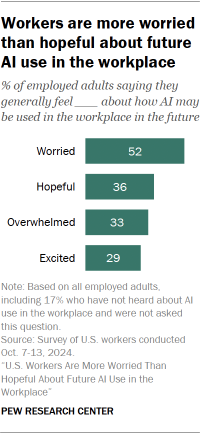
The headline finding is stark: 52% of U.S. workers feel worried about AI’s future impact in the workplace, compared to 36% who feel hopeful. About a third (32%) believe AI will shrink their job opportunities in the long run, while only 6% see it expanding them. Meanwhile, 33% report feeling overwhelmed, a sentiment that spikes to 40% among workers aged 18-29. These numbers paint a picture of a workforce grappling with uncertainty, and they signal a pressing need for HR to bridge the gap between apprehension and action.
What’s driving this unease? For many, AI remains an abstract force. Seventeen percent of workers surveyed hadn’t even heard of its use in the workplace, highlighting a significant awareness gap. Among non-AI users (81% of respondents), 45% believe their jobs can’t be meaningfully performed with AI. An assumption HR leaders must interrogate as automation capabilities evolve. The data suggests a workforce split between those who fear displacement and those who simply don’t see AI’s relevance yet. Both perspectives pose risks if left unaddressed.
Who’s Using AI. And Who Isn’t?
The report reveals distinct demographic patterns in AI adoption. Only 16% of workers currently use AI for at least some of their tasks, with younger (under 50) and more educated (bachelor’s degree or higher) employees leading the charge. AI users are also more likely to work in urban areas, handle data-processing tasks, or operate in sectors like information technology (12% usage) and finance (10% usage). By contrast, non-AI users (63% of whom say they don’t use AI much or at all) tend to be older, less educated, and more rural-based.
Interestingly, among non-AI users, 31% acknowledge that at least some of their work could be done with AI. This potential-use cohort is a goldmine for HR leaders. It’s where education and upskilling can shift perceptions from resistance to readiness. The generational divide is particularly telling: 34% of non-AI users under 50 see AI applicability in their roles, compared to just 25% of those over 50. Education amplifies this further. 44% of non-AI users with a bachelor’s degree see potential, versus 22% with some college or less.
Chatbots: Speed Over Substance
AI chatbots like ChatGPT, Gemini, and Copilot offer a practical lens into workplace adoption. Only 9% of workers use them daily or weekly, with another 7% tapping in monthly. Usage skews young (23% of 18-29-year-olds engage at least monthly) and educated (26% of postgraduates). Among users, the top applications are research (57%), editing written content (52%), and drafting documents (47%). Less common? Creative ideation (35%) and data analysis (27%).
A key insight emerges when we look at perceived value: 40% of chatbot users find them extremely or very helpful for speeding up tasks, but only 29% say they improve work quality. This gap suggests workers see AI as a time-saver rather than a quality enhancer. For HR, this raises a question: are we deploying AI to merely accelerate existing processes, or to elevate outcomes? The answer could shape how we position AI tools to employees.
The Skills Conundrum
Training data adds another layer. Half of workers (51%) received job-related training in the past year, but only 24% of those sessions covered AI. Meanwhile, just 35% of workers rate AI skills as extremely or very important for success today, far below interpersonal skills (70%+) or critical thinking. Even among AI users, only 50% prioritise AI proficiency. This lukewarm valuation of AI skills contrasts sharply with its growing footprint, hinting at a disconnect between perception and reality.
For non-users, barriers to adoption are telling. Among the 69% who don’t use chatbots, 36% cite a lack of relevance to their job, 22% express disinterest, and 10% admit they don’t know how to use them. Older workers (50+) are more likely to cite skill gaps (13% vs. 8% for 18-49). Employers aren’t pushing hard either. Only 12% encourage chatbot use, with higher rates in tech (36%) and finance (24%). Half of workers say their employer is neutral, suggesting a leadership vacuum HR can fill.
A Framework for HR Leaders: The Three As
I see the Pew data as a map. To navigate AI’s integration, I propose a framework I call the Three As: Awareness, Alignment, and Advancement. Here’s how it applies:
- Awareness: Close the Knowledge Gap
Seventeen percent of workers haven’t heard of workplace AI, and 29% are unaware of chatbots. This isn’t ignorance, it’s an information void. HR must lead campaigns to demystify AI, using real-world examples tailored to roles. For instance, showing a warehouse worker how AI optimises inventory or a marketer how it refines targeting can shift mindsets. Awareness isn’t about hype; it’s about clarity. Start with internal webinars or bite-sized guides. Make it accessible, not overwhelming. - Alignment: Match Tools to Purpose
The gap between chatbot users finding them helpful for speeding up tasks vs those that say they improve the quality of work signals a misalignment. Workers value speed, but quality matters more for organisational impact. HR should audit AI tools to ensure they enhance outcomes, not just efficiency. For example, if chatbots are drafting reports, are they also improving accuracy or insight? Alignment means training managers to set expectations. AI isn’t a shortcut; it’s a partner. Pilot programmes in high-adoption sectors like IT or finance can model this approach. - Advancement: Build AI Fluency
Only a quarter of recent training touched AI, yet 31% of non-users see potential in their roles. HR must champion upskilling that’s practical and role-specific—think micro-credentials in AI basics for non-tech staff or advanced analytics for data roles. Tie this to career progression: if AI fluency boosts employability (as 15% of AI users believe), make it a tangible perk. Start small, offer opt-in workshops, and scale with demand.
The Opportunity Beneath the Worry
The report’s tone may sound cautious, but for HR leaders, it’s a call to action. Workers’ worry (52%) and overwhelm (33%) aren’t roadblocks, they’re signposts. They signal a workforce ready for guidance, not dictation. Upper-income workers (45% hopeful) and AI users (15% optimistic about opportunities) show us the flip side: exposure breeds optimism. HR can cultivate this by targeting the 31% of non-users open to AI’s potential. Convert curiosity into capability.
Consider this: industries like tech and finance, where AI adoption is higher, report more positive outlooks (16% and 11% see job growth). This isn’t coincidence, it’s correlation. Exposure reduces fear. HR can replicate this by fostering AI Familiarity Zones - safe spaces to experiment with tools like chatbots, backed by clear support. It’s not about forcing adoption; it’s about building confidence.
Act Now, Shape Tomorrow
The Pew findings underscore a truth we can’t ignore: AI isn’t waiting for consensus. It’s here, and its trajectory depends on how we steer it. HR leaders have a pivotal role - to transform worry into readiness and potential into progress. Start by auditing your organisation’s AI literacy (maybe using a tool like genAssess). Where are the gaps? Next, pilot an Awareness-Alignment-Advancement initiative in one department. Measure sentiment before and after. Share the results internally; let success build momentum.
This isn’t about chasing trends, it’s about leading with intent. The workforce isn’t rejecting AI; it’s asking for direction. Let’s provide it. What’s your first step?