Conservative voters are more optimistic about artificial intelligence than the country as a whole. According to Lord Ashcroft’s latest poll, 51 per cent of those who voted Conservative in 2024 see AI as wholly or mostly a force for good, compared with 42 per cent who see it as wholly or mostly a force for bad.

Yet 83 per cent of the same voters want government to do more to regulate the development of AI. The two instincts belong together: technological optimism needs political responsibility.
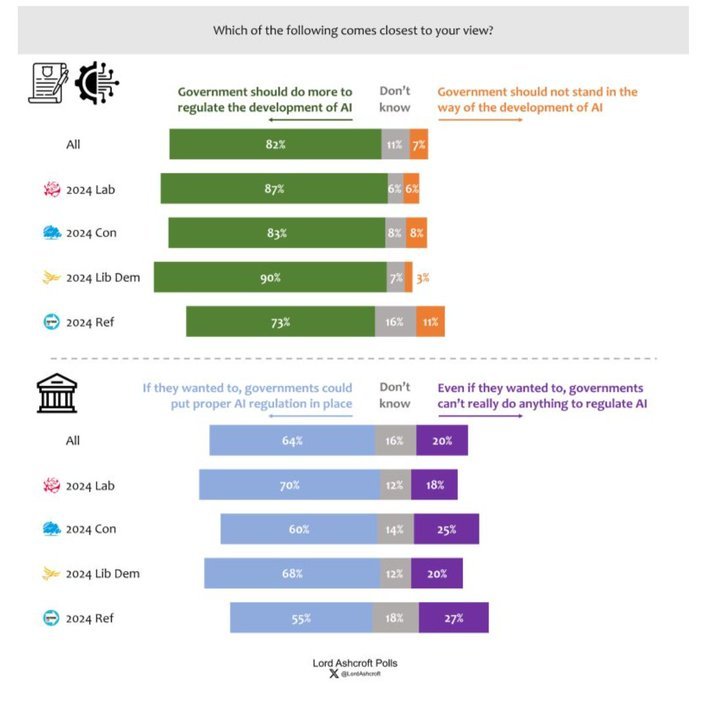
The survey of 5,039 adults in Great Britain, conducted between 24 and 28 September, found that the public overall is more apprehensive. AI was seen as a force for bad rather than good by 51 to 42 per cent. Even so, the most striking finding is the breadth of support for government action: 82 per cent of all respondents favoured more regulation, including large majorities across every principal voter group.
Conservatives should resist two equally unhelpful responses. One would treat public concern as proof that AI must be slowed or smothered. The other would dismiss regulation as inherently anti-growth. If we leave that false choice unchallenged, anxiety will eventually produce rules that are broader, blunter and less friendly to innovation than they need to be.
Markets need rules people can trust
The wording of the poll was broad. Respondents were not asked to choose between competing regulatory models and these figures are not an endorsement of the EU AI Act, a new super-regulator or state control of technological development. They do, however, show that a political offer based chiefly on regulatory restraint no longer commands public confidence.
That should not trouble Conservatives. Successful markets have always depended on enforceable property rights, contracts, competition and accountability when products cause harm. Clear rules protect liberty by preventing power from becoming arbitrary. They also give businesses the confidence to invest because responsibilities are known in advance.
AI creates a particular problem because responsibility can disappear into a chain of developers, vendors, employers and public bodies. An individual may be affected by a system they cannot inspect, challenge or even know is being used. When that system helps determine who gets a job, who is promoted, who receives a public service or whose behaviour is judged suspicious, the absence of effective rules is not neutrality. It leaves the weaker party carrying risks created by someone else.
Regulate consequences, not the AI label
The right dividing line is consequence. A tool that summarises meeting notes or suggests wording for an email should not face the same obligations as one that scores job applicants, monitors workers or recommends dismissal. Regulation should become more demanding as a system’s reach, autonomy and potential impact increase.
For consequential decisions, a sensible baseline is readily understood. People should know when automation has materially influenced an outcome. The organisation using it should be able to show that it works, monitor whether particular groups are being disadvantaged and provide a meaningful route to challenge serious errors. Responsibility for harm must be clear.
This is already relevant to employment. The Information Commissioner’s Office reported in March that it had engaged more than 30 employers about automated recruitment decisions and that 16 organisations had committed to improving their practices. The regulator accepted the gains from automation while insisting that faster decision-making must remain lawful, fair and transparent.
Having spent much of my career in recruitment, I know why that distinction matters. An employer may select the technology, a supplier may design the scoring system and a recruiter may act on its ranking. A rejected applicant should not be left circulating between them while each insists that somebody else made the decision.
The employer deploying a system must remain accountable for its use. In turn, suppliers should provide the evidence, records and access that employers need to test what they are buying. Government should follow the same principle in its own procurement rather than becoming dependent on whatever claims a technology provider chooses to disclose.
Poor regulation would protect the largest companies
There is a serious counterargument. Detailed approval processes, expensive reporting duties and rules tied to today’s technology could slow useful adoption. Large technology companies can absorb those costs more easily than British start-ups, turning regulation into a barrier that protects incumbents.
That risk is real, which is why proportionality matters. Duties should be attached to what a system does, the number of people it affects and the seriousness and reversibility of its decisions. A small company using AI to draft a job advertisement should not carry the same burden as a platform screening millions of candidates.
Government should also be willing to experiment. Small, controlled trials can test whether a technology improves real outcomes. Projects should expand when the evidence justifies it, change when weaknesses emerge and stop when they fail. That approach combines innovation with fiscal discipline and avoids turning either enthusiasm or fear into policy.
For public-sector AI, three questions would provide a useful discipline: does it improve the intended real-world outcome, who benefits and who may be excluded and is the result worth the cost to taxpayers? Those questions are more valuable than counting pilots, users or press releases.
Trust is part of the infrastructure for growth
Ashcroft’s second finding deserves attention too. Sixty-four per cent of respondents believed governments could establish proper AI regulation if they chose to, while 20 per cent thought governments could do little even if they wanted to. Among 2024 Conservative voters the figures were 60 and 25 per cent respectively.
That quarter of Conservative voters expresses a familiar scepticism about state competence. Government should not answer it with grand claims that every risk can be eliminated. It should choose enforceable priorities, use institutions that already understand their sectors and demonstrate that rules have practical consequences.
Public confidence is not a decorative addition to AI policy. Employers will hesitate to deploy systems that staff and applicants regard as illegitimate. Public bodies will retreat after avoidable failures. Each scandal will strengthen demands for moratoria or blanket restrictions. Proportionate rules can therefore accelerate responsible adoption by giving people and organisations confidence about where the boundaries lie.
Lord Ashcroft’s poll does not show a public rejection of AI, and it gives government no blank cheque for intervention. It reveals an electorate that expects innovation to remain answerable to democratic rules. Conservatives are well placed to offer that settlement: freedom for low-risk experimentation, enforceable duties where decisions have serious consequences and responsibility attached to those with the power to act.
If we decline to shape those rules now, public fear will eventually write harsher ones for us.