As recruitment and HR leaders, we’re no strangers to technology promising to make our jobs easier. In the area of Conversational AI, the latest trend sees vendors championing Large Language Models (LLMs) as the ultimate solution, claiming they can handle it all — conversation design, intent recognition, even context management. But is that truly the case? Should we be entrusting such a crucial aspect of candidate experience to an LLM-driven solution without a second thought?
Before we dive headfirst into adopting the next big thing in AI, let’s take a moment to examine whether these claims hold up, and more importantly, how we can make better decisions when investing in Conversational AI technology.
The Flawed Promise of “LLM-Only” Chatbots
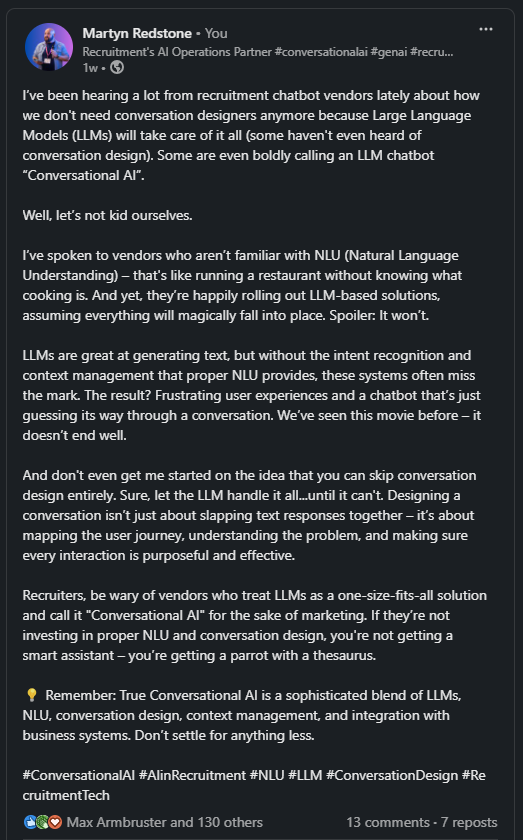
There’s a growing narrative that LLMs, with their ability to generate convincing text, can replace traditional elements like Natural Language Understanding (NLU) and conversation design entirely. Some vendors are even referring to their solutions as “Conversational AI” without incorporating these essential features. This is concerning. Without NLU, LLM-based systems often fall short in recognising user intent and managing context — the bedrock of effective conversations in recruitment.
Think about your candidate interactions for a moment. It’s not enough for a chatbot to simply generate a response; it must understand the question. If it fails to grasp the candidate’s intent or the specific context of their query, what follows is a series of guesses. And this doesn’t just lead to frustration — it risks damaging your organisation’s employer brand. After all, a poorly executed chatbot interaction reflects directly on your company.
Why We Need More Than Just LLMs
Incorporating LLMs into recruitment chatbots isn’t inherently wrong. In fact, when used correctly, they can significantly enhance user engagement, handling unstructured queries that more rigid systems struggle with. However, LLMs must be part of a broader conversational architecture that includes NLU, proper conversation design, and context management.
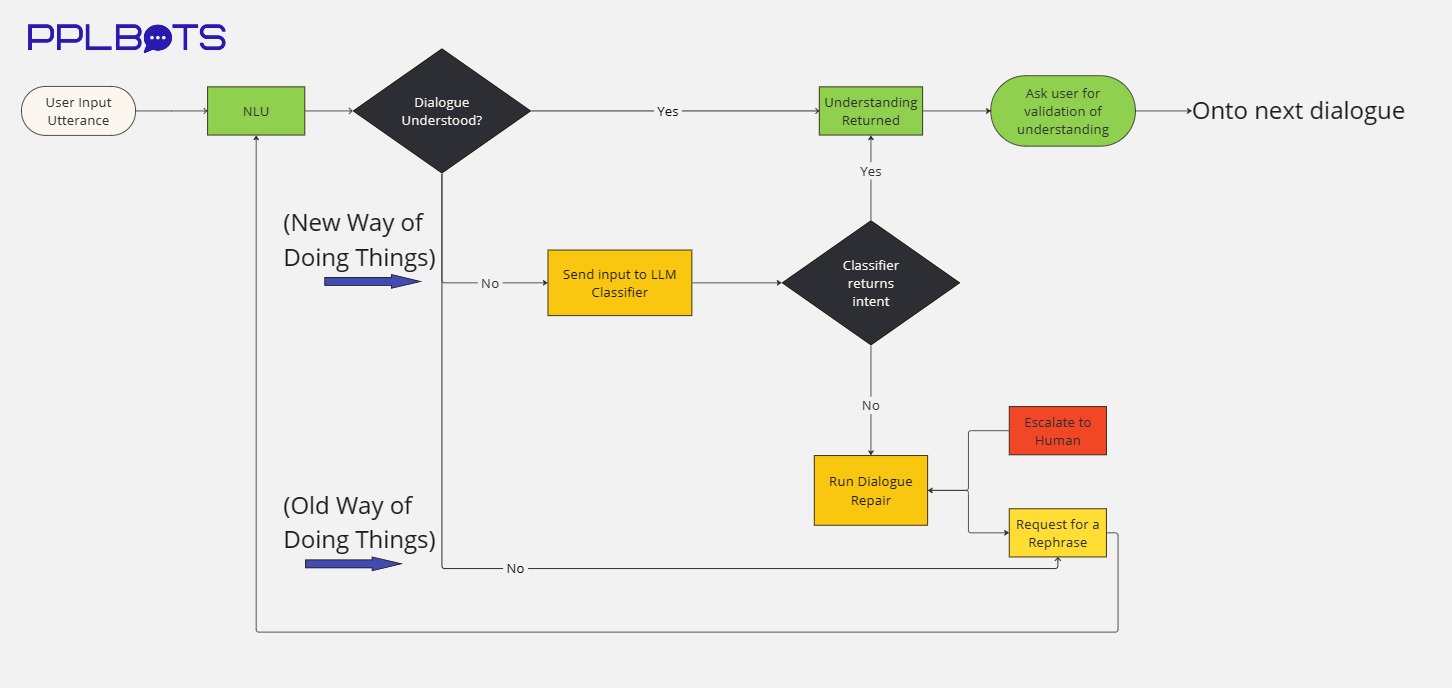
In my above diagram, I illustrate a hybrid approach that incorporates both traditional NLU and LLMs, using the strengths of each. When a chatbot can’t understand a query through NLU alone, it passes the input to an LLM for more flexible handling. The result? You maintain control over simpler, high-volume queries while still benefiting from the LLM’s ability to tackle more complex cases. This approach prevents the chatbot from relying solely on guesswork, ensuring that your candidates are getting accurate, helpful responses.
Key Considerations When Investing in Conversational AI
So, how can recruitment and HR leaders make smarter decisions when evaluating Conversational AI solutions? Here are a few questions to keep in mind:
- Does the solution include both NLU and LLM capabilities?
Ask vendors to break down how their system processes language. If they’re relying exclusively on an LLM, be cautious. Without NLU, the chatbot may struggle to understand structured data, which is vital for effective candidate interactions. - Is there a clear investment in conversation design?
Chatbots should not just regurgitate pre-written responses. Effective conversation design maps out the candidate journey, ensuring every interaction has a purpose and progresses logically. If conversation design isn’t a priority for the vendor, the chatbot may feel disjointed and robotic. - How is human escalation handled?
Even the best AI systems have limitations. There needs to be a clear path to human intervention when the system can’t resolve a candidate’s query. This keeps the candidate experience seamless, ensuring they aren’t left hanging. - Is the system adaptable and scalable?
As your organisation grows and changes, so too should your technology. A strong Conversational AI platform will learn from interactions and improve over time. Make sure the system can scale with your recruitment needs and adapt to new challenges as they arise. - How well does it integrate with your existing systems?
No matter how advanced the AI, it needs to play well with others. Ensure the chatbot integrates smoothly with your Applicant Tracking System (ATS) and other HR tools. This will reduce administrative headaches and ensure a consistent flow of information across platforms.
The Importance of Intent and Context in Recruitment
The success of a recruitment chatbot hinges on its ability to correctly interpret intent and manage context. Think of the myriad queries candidates might pose: application status updates, interview scheduling, or even more nuanced questions about your company culture. If the chatbot can’t differentiate between these intents, or if it loses track of the conversation’s context, the interaction quickly becomes frustrating.
In my LinkedIn post, I compared relying solely on LLMs to running a restaurant without understanding cooking. It might look impressive from the outside, but without the essential foundations, the result is messy and ultimately ineffective.
True Conversational AI: A Balanced Solution
At the end of the day, investing in Conversational AI is about more than just adopting the latest shiny tool. It’s about ensuring that your recruitment processes are supported by a balanced, well-thought-out system that understands your candidates and meets their needs.
True Conversational AI is a sophisticated blend of LLMs, NLU, conversation design, and context management. These elements, working together, can transform the candidate experience, ensuring that every interaction — from initial engagement to the final offer — is as smooth and efficient as possible.
The hybrid model discussed in my LinkedIn post and visualised in the diagram ensures that we don’t rely on guesswork, but instead use each system’s strengths for a more streamlined candidate experience.
Don’t settle for less. When evaluating vendors, ask the tough questions, dig into how their systems work, and make sure you’re investing in technology that will truly add value to your organisation. After all, your candidates deserve nothing but the best.
By keeping these considerations at the forefront, you’ll be better equipped to make informed decisions that not only enhance your recruitment efforts but also protect and strengthen your organisation’s reputation.