Executive Summary: The AI Workforce Imperative
AI is already transforming work, but most HR leaders are treating it as a future issue rather than a present-day reality. This manifesto outlines why HR must lead AI adoption, rather than react to it. AI is reshaping high-cognition, high-value jobs first (not low-wage roles) demanding urgent workforce strategy shifts. HR must act now by embedding AI literacy into hiring, workforce planning, and leadership development. Compliance, bias mitigation, and AI governance must become core HR priorities. AI isn’t replacing humans, it’s augmenting work, and HR leaders who don’t proactively integrate AI into their strategy will fall behind. The time to act is now.
Introduction: AI is Reshaping Work. HR Leaders Must Lead or Be Left Behind
For years, HR leaders have speculated about AI’s impact on work. That moment has arrived.
Artificial intelligence is no longer a distant disruptor. It is actively reshaping workforce structures, redefining job roles, and altering the very nature of work itself.
Yet, too many HR leaders remain in a reactive mindset, treating AI as a technology trend rather than the most fundamental shift in workforce strategy since the industrial revolution.
The Problem: HR is Playing Catch-Up
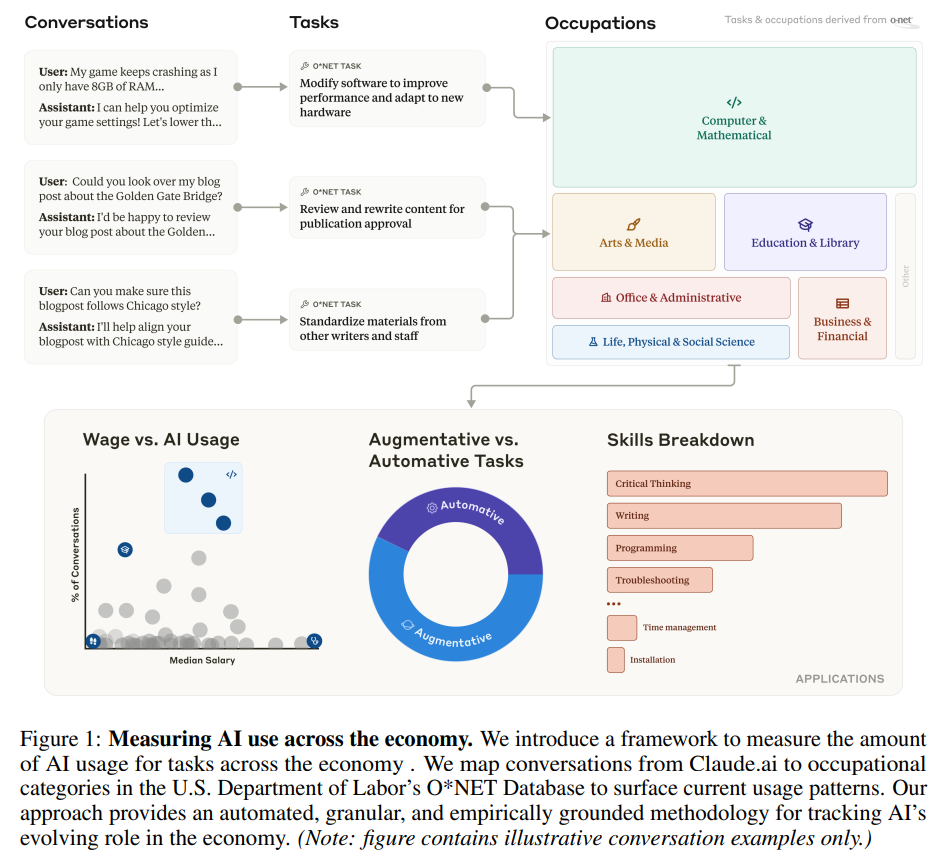
A recent study by Anthropic, Which Economic Tasks Are Performed with AI? Evidence from Millions of Claude Conversations, provides the most data-driven insights yet into AI’s real-world impact on work. Unlike speculative forecasts, this research is based on millions of real interactions with Claude AI, giving us a clear picture of how AI is currently being used, where it is expanding, and what this means for workforce planning.
The findings demand urgent action from HR leaders:
✅ AI is already deeply embedded in high-cognition, high-value knowledge work.
✅ AI is reshaping mid-to-high wage jobs first, rather than displacing low-income jobs first.
✅ AI isn’t replacing jobs outright, but it is shifting which skills are valuable. And fast.
This isn’t an IT issue. It’s a workforce strategy crisis.
AI is here. The only question is: Will HR lead the transformation or scramble to catch up?
AI’s Workforce Impact: The Hard Data HR Cannot Ignore
1. AI is Already Reshaping Knowledge Work. Not Just Low-Skilled Jobs
Forget the narrative that AI will first replace low-skill, routine jobs.
Anthropic’s data shows that software development and writing-intensive roles account for nearly half of all AI usage. AI is embedding itself not in low-skill jobs, but in highly skilled, knowledge-based work.
- Software Developers: AI is accelerating coding, debugging, and software optimisation.
- Writers and Content Professionals: AI is used for editing, summarisation, and drafting.
💡 HR Reality Check: AI is already enhancing work in high-value roles. If your company still thinks of AI as a “future disruptor”, you are already behind.
🔎 The Big Question for CHROs: If AI is augmenting your highest-value talent, what are you doing to ensure they are using it effectively?
HR leaders can no longer assume employees will “figure AI out”. This is where platforms like genAssess become critical.
2. AI is Expanding Across Industries, but HR is Lagging
📊 36% of occupations now use AI for at least 25% of their tasks.
AI is no longer confined to tech, finance, or professional services. It is rapidly expanding across legal, marketing, HR, and corporate functions.
However, the study also reveals slow adoption in physically intensive jobs like construction, healthcare, and logistics.
💡 HR’s Strategic Dilemma:
- If you work in an industry where AI adoption is low, you have a rare opportunity to proactively shape AI workforce strategies before disruption forces your hand.
- If your industry is already AI-heavy, your HR function is likely playing catch-up. How are you ensuring AI isn’t being adopted in silos?
🚨 Biggest Risk: AI talent shortages are no longer about engineers—they are about everyone. Companies that fail to integrate AI across job families will quickly fall behind competitors.
📌 HR’s Immediate Actions:
✅ Conduct an AI workforce audit to determine which roles are already AI-augmented.
✅ Train non-technical professionals in AI literacy before they become obsolete.
✅ Integrate AI competency assessments like genAssess into hiring processes.
3. AI is More About Augmentation Than Automation. For Now
The most significant finding from the study is that AI is augmenting more tasks than it is automating:
- 57% of AI interactions are augmentative—helping employees refine, iterate, or improve their work.
- 43% of AI interactions are automative—where AI takes over tasks with minimal human involvement.
📌 HR Reality Check:
HR leaders must stop seeing AI as just an automation tool. The biggest workforce risk today isn’t job losses, it’s underutilisation.
The companies that win the AI revolution won’t be those that cut jobs fastest, but those that embed AI into work most effectively.
4. AI Governance is an HR Imperative, Not Just an IT Concern
The piece rightly states that AI ethics, bias, and governance are HR’s responsibility, but it needs a more concrete roadmap for HR leaders.
🔎 HR Governance Must Cover Three Pillars:
1️⃣ Compliance & Regulation:
- Ensure hiring and performance AI tools comply with GDPR, EEOC, and the AI Act.
- Work with legal teams to review AI vendors - do their algorithms meet transparency standards?
2️⃣ Fairness & Bias Mitigation:
- AI models inherit biases. HR teams must actively audit AI-driven hiring and performance management tools using a tool like Warden AI.
- Introduce AI fairness checklists before deploying AI decision-making in talent processes.
3️⃣ Accountability & Transparency:
- AI decision-making must be explainable—if HR leaders can’t audit AI’s hiring choices, it shouldn’t be used.
- Establish HR-led AI governance councils to oversee AI workforce impact.
📌 What I’d Say to My Legal Counsel:
"We need an AI ethics policy, and we need it now. If we wait for regulators to dictate it, we’ll be playing defence instead of leading the charge."
5. Leadership Buy-In & Change Management is Overlooked
AI isn’t just a skills problem, it’s a leadership and culture problem.
🔎 HR Must Address:
- Managerial Resistance: Many mid-to-senior leaders don’t trust AI-driven decision-making and will resist change.
- Change Fatigue: Employees are already dealing with hybrid work shifts, economic uncertainty, and restructuring. HR must carefully manage AI transitions to avoid backlash.
📌 HR Action Plan:
✅ Provide AI fluency training for leadership teams—executives cannot lead AI transformation if they don’t understand it.
✅ Align AI strategy with organisational values—frame AI adoption as a tool to empower employees, not just increase efficiency.
The AI-Ready HR Playbook: How to Take Action Now
1. HR Must Lead AI Workforce Planning
HR leaders must map AI’s impact on job families and skills, not just react to automation threats.
📌 Start now: Conduct an AI workforce audit to assess which roles AI is already reshaping.
2. AI Literacy Must Be a Core Hiring & Development Focus
✅ AI fluency is now a key competency across industries.
✅ AI collaboration skills must be measured in hiring.
✅ HR must rethink how it evaluates job readiness in an AI-augmented world.
🚀 genAssess is a key tool to bridge this gap, ensuring AI literacy is evaluated as a hiring criterion.
Final Thought: HR Must Lead, or Be Left Behind
The future of work is not AI replacing humans, it is AI-augmented work.
HR leaders who fail to act now will find themselves reacting to AI-driven job disruptions instead of shaping how AI is used.
🔎 HR leaders—what’s your AI strategy? If you don’t have one, when will you?
AI isn’t waiting. Neither should you.