Recruiting Operations (RecOps) has become the backbone of modern talent acquisition, ensuring that processes, tools and strategies work together to attract, engage and hire the right talent. But as artificial intelligence (AI), automation and data-driven hiring become the norm, RecOps as we know it is no longer enough.
We don’t just need operations, we need engineering.
Enter the RecOps Engineer: a role designed to build and optimise the systems that drive recruitment efficiency, scale and impact.
Much like RevOps Engineers in sales or GTM Engineers in go-to-market strategy, the RecOps Engineer is the next step for organisations looking to turn hiring into a well-oiled machine rather than a reactive process.
Why Do Organisations Need RecOps Engineers?
RecOps teams have already made hiring more efficient, but that’s not enough. The challenges organisations face today require structural change, not just operational improvement.
- AI is changing hiring — automating sourcing, assessment and engagement
- Candidate expectations have shifted — they want personalised, transparent and seamless hiring experiences
- Speed and accuracy matter more than ever — top talent is snapped up quickly, and bad hires are expensive
- Skills-based hiring is on the rise — meaning recruitment teams need better ways to assess and match candidates
- Internal mobility is overtaking external hiring — requiring smarter workforce planning
A RecOps Engineer doesn’t just optimise these challenges—they build the systems that solve them.
What is a RecOps Engineer?
This isn’t just an operations role, nor is it purely technical. A RecOps Engineer sits at the intersection of technology, data and talent strategy, bridging recruitment, automation and business impact.
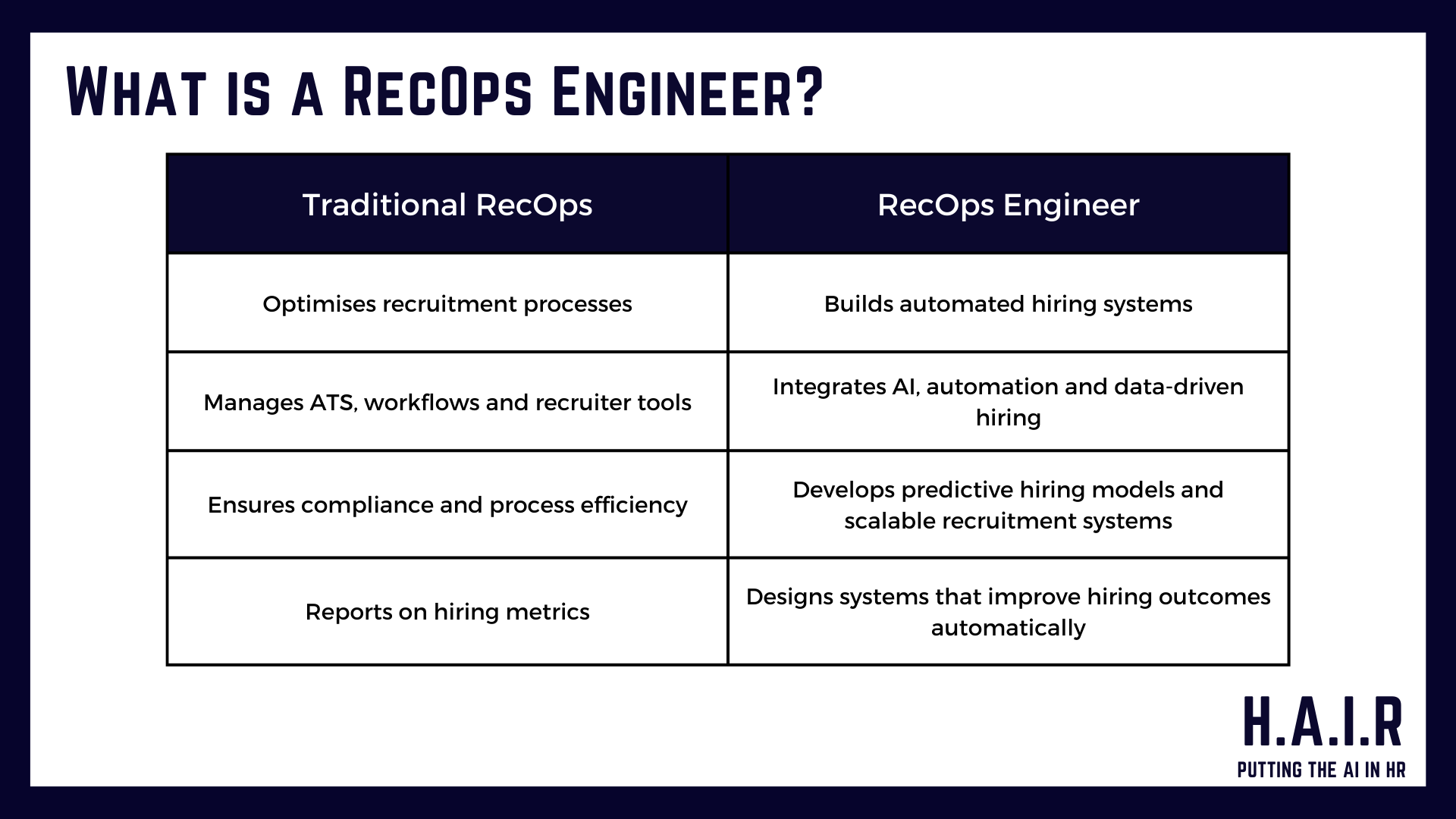
In short, RecOps Engineers don’t just run recruitment operations, they build the infrastructure that makes hiring better, faster and more predictable.
What Does a RecOps Engineer Actually Do?
A RecOps Engineer’s role is more than just refining hiring workflows. They actively design, build and optimise recruitment infrastructure.
1. AI-Driven Hiring Automation
- RecOps Engineers integrate AI into the hiring process, eliminating manual work and improving efficiency. This includes:
- AI-powered sourcing that continuously identifies top candidates
- Automated outreach, follow-ups and scheduling
- Chatbots and virtual hiring assistants for candidate interactions
- Intelligent screening tools that prioritise the best applicants
Example: Instead of manually sourcing candidates, a RecOps Engineer integrates AI-driven talent intelligence and workfroce planning tools that proactively identify top talent, before recruiters even know they need them.
2. Advanced Data & Analytics for Hiring
It’s not enough to track hiring metrics. RecOps Engineers use data to predict and optimise outcomes.
- AI-driven lead scoring to rank and prioritise candidates
- Predictive hiring models to forecast talent needs
- Real-time recruiter productivity dashboards
- Quality-of-hire analytics that link hiring decisions to long-term success
Example: Instead of reporting on time-to-hire after the fact, a RecOps Engineer builds a model that predicts bottlenecks in the hiring process and fixes them proactively.
3. Workforce Planning & Internal Mobility
Rather than always looking externally for talent, RecOps Engineers ensure organisations make the most of their existing workforce.
- Mapping internal talent pools for future roles
- AI-driven career pathing to suggest upskilling opportunities
- Workforce planning tools that predict hiring needs before vacancies arise
Example: Instead of recruiting externally for every role, a RecOps Engineer ensures that AI-driven internal mobility tools surface existing employees who are ready for promotion or a lateral move.
4. AI-Enhanced Candidate Experience
The best hiring systems don’t just work efficiently—they create a seamless and engaging experience for candidates.
- AI-driven chatbots handle FAQs, scheduling and interview prep
- Personalised career site recommendations based on visitor behaviour
- AI-generated recruitment marketing campaigns tailored to talent segments
Example: A RecOps Engineer integrates real-time personalisation into a company’s careers site, ensuring each visitor sees roles and content tailored to their skills, experience and preferences.
5. HR Tech Stack Engineering & Systems Integration
The RecOps Engineer is responsible for building a scalable recruitment infrastructure, ensuring all hiring systems work together.
- Seamless integration of ATS, HRIS and recruitment automation tools
- AI-driven process automation for recruiters and hiring managers
- Automated data flow between recruitment, HR and business intelligence
Example: Instead of recruiters manually entering candidate data, a RecOps Engineer ensures that every touchpoint (from initial application to hire) feeds automatically into the ATS and HRIS, eliminating admin work.
Who Should Be a RecOps Engineer?
This isn’t an entry-level role. A RecOps Engineer needs a blend of recruitment knowledge, data expertise and technical skills.
Essential Skills:
- AI & Automation – Understanding how to integrate AI into hiring processes
- Data Analytics & Workforce Planning – Ability to use hiring data for predictive decision-making
- HR Tech Stack Expertise – Experience working with ATS, HRIS and automation tools
- Process Engineering – Skilled at building and optimising hiring workflows
- Cross-Functional Collaboration – Comfortable working with HR, IT, recruitment and leadership teams
Typical Backgrounds:
- 6-8+ years in talent acquisition, RecOps or HR tech
- Experience in data analytics, automation or process improvement
- A track record of implementing recruitment technology
How to Measure the Success of a RecOps Engineer
Unlike traditional recruiters, RecOps Engineers aren’t measured by the number of hires they make. Their impact is seen in efficiency, automation and hiring quality.
Key Metrics for RecOps Engineers:
- Time-to-hire reduction (through automation and AI sourcing)
- Recruiter productivity (more time spent on strategic work, less on admin)
- Quality-of-hire improvement (AI helping identify better matches)
- Cost-per-hire reduction (by eliminating inefficiencies)
- Internal mobility success (more roles filled by existing employees)
Final Thoughts: Is the RecOps Engineer the Future of Hiring?
The RecOps Engineer isn’t just a new job title. It represents a fundamental shift in how organisations approach hiring.
- Hiring is becoming a system, not just a process.
- AI and automation are no longer optional, they’re essential.
- Companies that engineer their hiring functions now will have a competitive edge.
For organisations looking to scale, improve hiring accuracy and create a seamless candidate experience, hiring a RecOps Engineer isn’t a luxury, it’s a necessity.
Your Next Steps
- Are you a recruitment leader? Start thinking about how automation, AI and data can enhance your hiring strategy
- Thinking of becoming a RecOps Engineer? Upskill in automation, workforce analytics and recruitment technology
- Hiring a RecOps Engineer? Look for professionals who bridge recruitment, data and systems.
The future of hiring isn’t just about filling roles—it’s about engineering the infrastructure that makes great hiring inevitable.