Have you been to a Recruitment or HR conference lately? If so, you've likely heard the same message repeated: AI is coming, and you need to jump on board now or risk being left behind. But amidst all the buzzwords and grand predictions, are we really clear on what AI can do for us in HR and recruitment?
Let's take a step back and look at the different types of AI tools available. We'll explore Assistants, Copilots, and Agents - terms often used interchangeably, but which actually represent distinct levels of AI capability. Understanding these differences is crucial for making informed decisions about implementing AI in your HR and recruitment processes.
The AI Autonomy Spectrum: What's What?
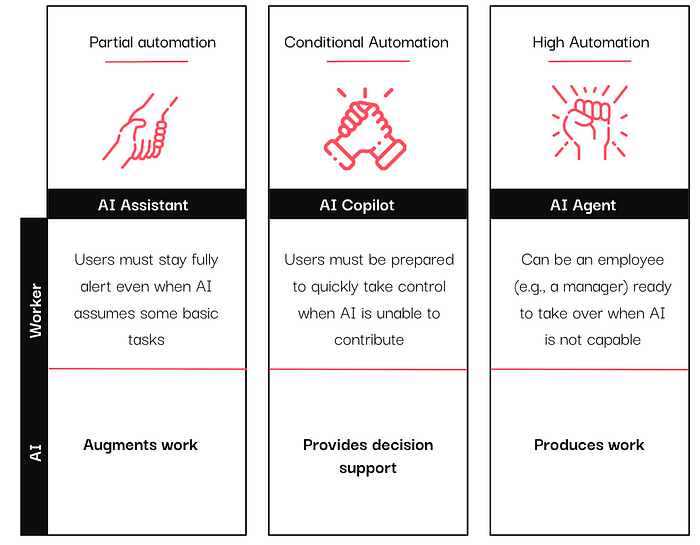
(Three levels of autonomy — Image adapted from original by Bain Capital Ventures)
Think of AI tools on a spectrum of autonomy:
- AI Assistants: Low autonomy
- AI Copilots: Medium autonomy
- AI Agents: High autonomy
Let's delve into each of these and see how they might fit into your HR and recruitment strategies.
AI Assistants: Your Digital Helper
AI Assistants sit at the low end of the autonomy spectrum. They're designed to support specific tasks based on predefined rules.
In HR and recruitment, an AI Assistant might:
- Generate job descriptions from role requirements
- Answer common HR policy questions
- Search candidate databases efficiently
- Optimise job postings for various platforms
The key thing to remember about AI Assistants is that they assume you know what you're doing. They're great for making your existing processes more efficient, but they won't make decisions for you.
For instance, an AI Assistant could help you quickly find candidates with specific skills, but it won't decide who to interview or hire. It's a bit like having a very efficient personal assistant who can find information quickly but doesn't make judgement calls.
AI Copilots: Your Collaborative Partner
Moving up the autonomy scale, we find AI Copilots. These systems not only boost productivity but also support decision-making. The term "Copilot" suggests a partnership between you and the AI.
In HR and recruitment, an AI Copilot could:
- Analyse CVs and suggest suitable candidates
- Provide insights on market salary trends
- Recommend interview questions based on job requirements
- Suggest tailored onboarding plans
AI Copilots can make recommendations and provide insights, but they still need you to ask the right questions and make final decisions. It's like having a knowledgeable colleague who can offer valuable input, but ultimately leaves the decision to you.
AI Agents: Your Autonomous Decision-Maker
At the high end of the autonomy spectrum are AI Agents. These are the most advanced AI systems, capable of making decisions and taking actions independently to achieve specific goals.
In HR and recruitment, an AI Agent might:
- Screen and shortlist candidates autonomously
- Conduct initial interview rounds
- Analyse workforce data and implement retention strategies
- Optimise job postings across platforms based on performance data
The key difference with AI Agents is their ability to operate independently and make decisions. It's like having a team member who can take on entire processes from start to finish, making decisions along the way.
Choosing the Right AI Tool: What Should You Consider?
As you think about bringing AI into your HR and recruitment processes, it's important to consider which level of autonomy is right for different tasks. Here are some questions to ponder:
- How complex is the task? More nuanced tasks might need human oversight, making Assistants or Copilots more suitable.
- What's the risk level? For high-stakes decisions, you might prefer the collaborative approach of a Copilot over an Agent's autonomy.
- What are your volume and speed requirements? If you need to process loads of data quickly, an Agent might be more efficient.
- How expert are your users? Highly skilled teams might benefit most from an Assistant that streamlines their processes, while less experienced users might gain more from a Copilot's guidance.
- Is your organisation ready? Implementing autonomous AI Agents requires a significant level of trust in AI systems. Is your team prepared for this shift?
The Future of AI in HR and Recruitment: What's Really Possible?
While the potential of AI in HR and recruitment is exciting, it's important to approach it with a clear head. Many of the use cases being discussed, especially for AI Agents, are still theoretical or in early stages.
As you explore AI solutions, be wary of vendors who blur the lines between these categories or promise Agent-level autonomy for tasks that are currently better suited to Assistants or Copilots. Always ask for concrete examples of how their AI tools have been successfully implemented in real HR and recruitment scenarios.
Remember, the goal of implementing AI should be to enhance your team's capabilities, not to replace human judgment entirely. The most successful AI implementations in HR and recruitment will likely be those that find the right balance between AI capabilities and human expertise.
In conclusion, while AI is becoming an integral part of HR and recruitment, there's no need to panic if you haven't fully embraced it yet. Take the time to understand the different levels of AI autonomy, carefully assess your needs, and choose the right tools to augment your team's capabilities.
What's your next step? Perhaps it's time to assess your current processes and identify areas where AI could add value. Or maybe you need to have a conversation with your team about their readiness for AI integration. Whatever it is, remember that the key is to move forward strategically, not hastily. After all, the goal is to enhance your HR and recruitment processes, not complicate them.